
Union County Court Record Requests
The right record route starts with the court that accepted the filing. The Clerk of the Eighth Judicial District Court, Union County location is the custodian for a District Court case file. Magistrate and Clayton Municipal matters have separate clerk channels. The Administrative Office of the Courts is not the custodian of a Union County case file, so a request should name the Eighth Judicial District and the particular court when known.
- Identify the court, case number if known, and the exact item needed, such as a docket entry, order, filing, exhibit, transcript, ordinary copy, or certified copy.
- Use New Mexico Case Lookup for a free basic case-information check. It cannot supply document images.
- Use registered re:SearchNM for authorized online case or document review, recognizing that profile and security rules can limit access.
- Contact the responsible clerk for inspection, an ordinary copy, or a certified-copy question. The official sources publish District and Magistrate locations, phone numbers, fax numbers, and filing emails, but do not publish a Union County mail, fax, or email procedure for complete-record or certification requests.
- Use the judiciary IPRA form for a formal request routed to the responsible court, then ask the clerk for a cost estimate before ordering.
These channels have different functions. Case Lookup helps identify a case but does not provide documents. re:SearchNM can provide authorized online review but does not override legal limits. The clerk is the source for a court-held ordinary or certified copy, and the IPRA form is the formal statewide routing tool. The sources do not establish a single local procedure for sending complete-record requests by mail, fax, or an email filing address, so call before using one of those methods.
The Eighth District Clerk Holds District Court Files
For a Union County District Court matter, the local Eighth Judicial District clerk is the court-file contact. The courthouse counter is the direct place to ask where a case-specific request belongs, whether inspection is available, and how to obtain an authenticated clerk product. Do not substitute the Union County government office for the Judicial Branch clerk.
Clerk of the Eighth Judicial District Court, Union County location
100 Court St., Suite 5
Clayton, NM 88415
575-374-9577
Weekdays, 8:00 a.m. to 4:00 p.m.
The Eighth Judicial District Help Desk page says public computers are available during posted hours.
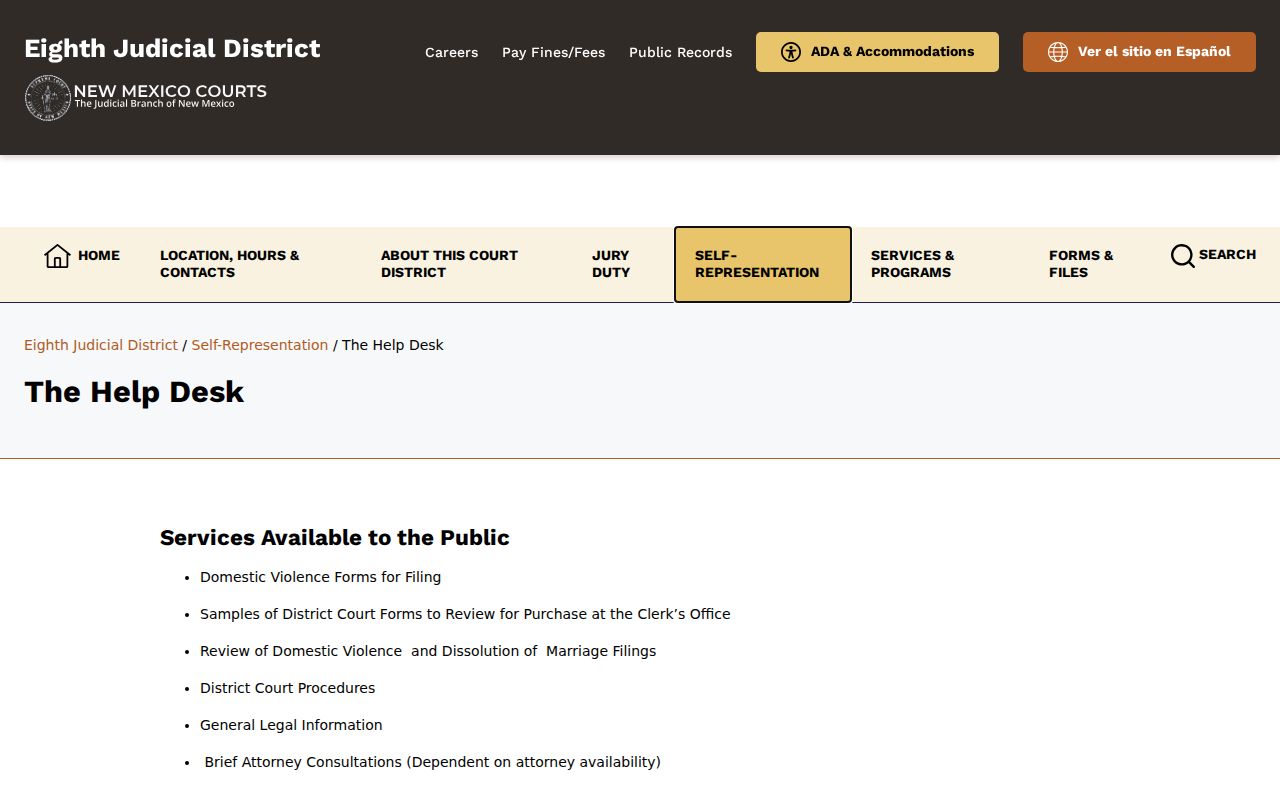
That page does not establish that a public computer is located at the Union County courthouse or what a terminal there could access. Call before relying on an in-building device.
District Court public hours are stated as 8:00 a.m. to 4:00 p.m. on weekdays, open through the noon hour. The research did not locate a counter cut-off for copy requests, a public-terminal count, a terminal-access rule, or a district clerk named as an individual. Use the office title and the published contact information rather than guessing at a person or service capability.
Kinds of Court Records
Rule 1-079’s court-record scope includes documents, papers, exhibits, transcripts, and the register of actions or docket entries. What can be inspected or copied depends on the court that holds the file and on any sealing, confidentiality, or access restriction. A district case can contain a different mix of material from a Magistrate or Municipal case, so describe the item rather than asking generically for “everything.”
- Register of actions, docket entries, or the re:Search Events/Filings chronology.
- Pleadings and other filed documents, where public access permits.
- Orders, judgments, and clerk certifications or seals when requested.
- Exhibits and transcripts within the scope of the court record and any access rule.
- Case-detail information such as number, title, location, category, type, filed date, judge, and status.
For an older Union County case, the judicial access page directs records before 1997 to the IPRA online form. That direction does not establish an archival storage site, microfilm index, or retrieval time. Give the oldest useful date range and the court name in the request, then let the custodian identify the available record path.
New Mexico Judicial IPRA Form Details
The formal route is the New Mexico judicial IPRA request form. Its blank interface includes a required Court Location selector and fields for the requesting person’s first name, last name, email address, phone number, address components, record subject, type of records, case number, and a required narrative description. It also requires a CAPTCHA before submission.
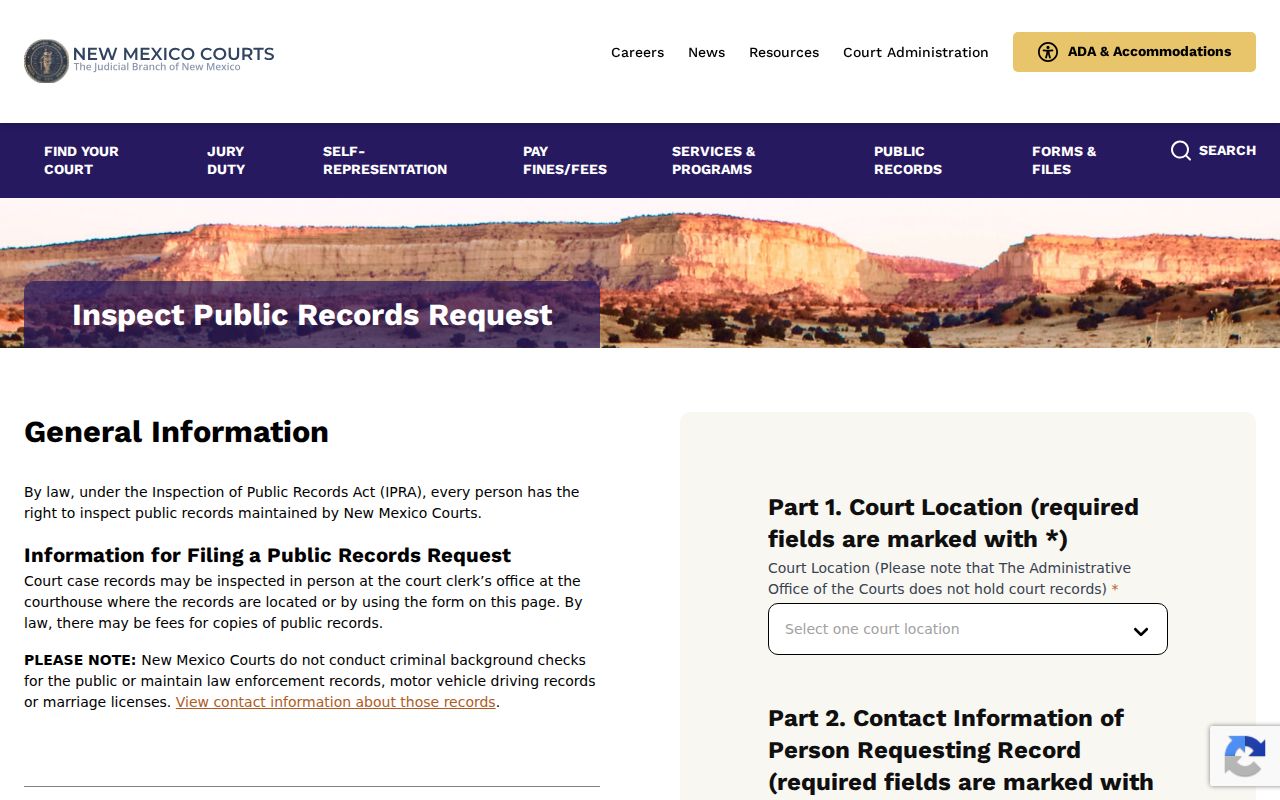
For a Union case, choose or identify the Eighth Judicial District and the responsible court when known. The form explains that NMSA 1978, Section 14-2-8(D) requires name, address, telephone number, and a reasonably particular record description, but no reason for the request. The research did not locate a published response clock or flat IPRA fee for this court.
A reasonably particular request might identify a case number and “signed final order,” or, if the number is not known, a court, names associated with the case, date range, and document type. Avoid a broad speculative request when more identifiers are available. The form’s court-location selector is intended to route the request; select the responsible judicial court rather than treating the AOC as the record custodian.
Court Records: What They Contain
A docket is an activity index, while a court record is broader. The re:Search guide separates Events/Filings from Documents. A visible filing event does not mean an image of the filing is available. Document detail can show a date, event, type, filing summary, name, comments, documents, pages, and a Document Security description, but access can still depend on the user’s profile, relationship, jurisdiction, and the record’s legal status.
| Case header | Case description, case number, location, category, type, filed date, interim conditions, judge, and status. |
|---|---|
| Events / Filings | Chronological case activity. The guide says the two terms are interchangeable in New Mexico. |
| Documents | Filed images or attachments when access permits; an entry can exist without public document availability. |
| Hearings | Date/time, hearing type, judge, location, result, and sometimes comments or reschedule/cancellation reasons. |
| Related material | Related cases, parties, attorneys, charge summaries, exhibits, and transcripts as applicable to the file. |
A hearing result is also different from a final case disposition, and a related case panel is not proof that two dockets are the same. The record should be read field by field. The official guide supports descriptions of its labels, but no Union-specific docket-code glossary, case-number-pattern table, or status-code lexicon was located. Confirm an unfamiliar label with the court that maintains the file.
A Docket Entry May Not Include Its Document
Case Lookup is case-information access only and has no document images. re:SearchNM can offer documents for authorized users, but its document-security field and access tiers matter. A document may be unavailable because it is sealed or confidential, because the profile or relationship does not permit access, or because a jurisdictional rule applies. An online result is not a certified court record.
Rule 1-079 is also why public access should not be described as unlimited. It covers the docket and the broader record, presumes access subject to law, and recognizes sealed and protected categories. Ask the clerk for the proper way to inspect or request a particular public item rather than assuming every item behind a visible event can be downloaded.
Copy Fees and Certification
An ordinary reproduced copy and a clerk-certified copy are different requests. The Eighth Judicial District schedule lists a per-page reproduction charge and a separate certificate/seal or authentication charge. It does not state that a certified-copy order costs only the certificate amount, so ask the responsible clerk for the total before ordering. The same schedule does not publish a Union County search fee, email-delivery fee, postage charge, expedited fee, online-image fee, or turnaround time.
| Item | Amount |
|---|---|
| Reproduced copy | $0.35 per page |
| Certificate / seal / authentication | $1.50 each |
| Tape or CD | $4.00 |
| Search, email, postage, expedited, or online-image fee | Not located in the official Union County sources |
The Eighth Judicial District fees, costs, and filing schedule is the official local source for these listed amounts and payment methods.
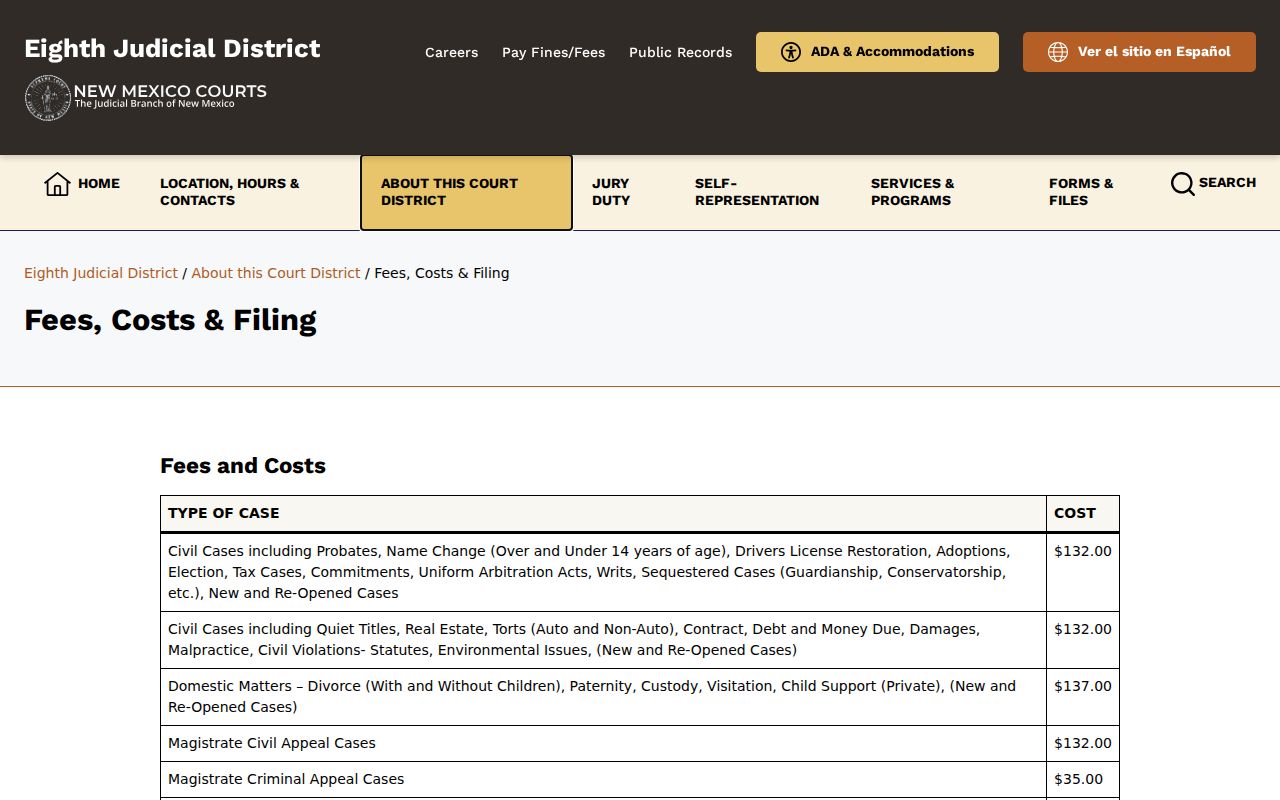
The schedule accepts cash, money order, cashier’s check, and credit card. It says personal checks are not accepted.
Do not calculate a universal total from the fee table. A multipage order can involve the per-page charge and a requested certificate or seal, while the sources do not specify all possible handling costs. Ask the clerk for the complete charge before placing an order and confirm which payment method the office can take for that request.
When a Certified Court Copy Is Needed
State whether an ordinary reproduced copy or a clerk certification is needed when contacting the court. Give the case number, court, document description, and the relevant date where known, then ask for the total charge and how the court wants the request made. The research located no Union-specific certified-copy order form, counter cut-off, mailed-copy checklist, or promise of same-day production.
Certified copies are clerk products, not a feature of Case Lookup or an automatic consequence of finding a record in re:SearchNM. The clerk can explain the appropriate court-file request path, but certification does not make restricted material available. For Magistrate records, call first because official sources list two different office locations during the reported co-location transition.
For the Union County Magistrate Court, the statewide directory lists 836 Main Street, Clayton, while Eighth District sources list 100 Court Street, Suite 5, Clayton. Both list 575-374-9472. That conflict is an access precaution, not evidence that either address is wrong. A phone call can identify the current counter before a records-request visit.
Access Rules for Court Records
New Mexico law begins with public access, not unrestricted online availability. Rule 1-079 makes court records subject to public inspection unless a court order or another rule protects them. It also limits personal identifiers: the rule provides for only the last four digits of Social Security, tax, financial-account, and motor-vehicle-license numbers, and year only for birth dates. Case Lookup separately states that Social Security numbers and addresses are unavailable.
Some records are automatically sealed or confidential, and the court can order sealing. Guardianship and conservatorship proceedings have specific confidentiality under Rule 1-079.1, although the docket can remain accessible with medical and similar protected information excluded. Sealing, confidential access, restricted online availability, and expungement are distinct statuses with different procedures.
Key Rules:
Rule 1-079 NMRA governs public inspection, redaction, and sealing of court records.
Rule 1-079.1 NMRA addresses confidentiality boundaries for guardianship and conservatorship records.
Rule 1-077.1 NMRA addresses the distinct court expungement procedure.
In-person public access has its own identity requirement under Rule 1-079: name, address, telephone number, and government or other acceptable identification. That rule does not promise every record will be released simply because a request contains the required identity information. A sealed, confidential, or restricted item remains subject to the governing rule, order, and court process.
Make a Union County Request Reasonably Particular
Specificity improves routing without requiring a requester to explain why the record is wanted. Include the exact case number when available. If it is not known, give the court, names associated with the case as appropriate, a date range, record type, and a description such as “signed order entered on or about [date]” or “register of actions for this case.” Those details help the clerk or IPRA form identify the requested material.
For in-person public inspection, Rule 1-079 requires a requester’s name, address, telephone number, and government or other acceptable identification. The judicial access page says records before 1997 should be requested through the IPRA online form. No separate Union County archival location, microfilm index, retrieval delay, or public-terminal capability was located, so confirm the request method and cost with the responsible clerk.